Rocky Horror Picture Show Fox Performing Arts Center October 13
| The Rocky Horror Picture show Show | |
|---|---|
 Theatrical release poster | |
| Directed by | Jim Sharman |
| Screenplay by |
|
| Based on | The Rocky Horror Bear witness by Richard O'Brien |
| Produced by |
|
| Starring |
|
| Narrated past | Charles Grey |
| Cinematography | Peter Suschitzky |
| Edited by | Graeme Clifford |
| Music by |
|
| Production | Michael White Productions |
| Distributed by | 20th Century Fox |
| Release appointment |
|
| Running time | 100 minutes[i] [2] |
| Countries |
|
| Language | English language |
| Budget | $1.iv meg[4] |
| Box office | $226 million[5] [ needs update ] |
The Rocky Horror Picture Bear witness is a 1975 musical comedy horror film by 20th Century Play a trick on, produced by Lou Adler and Michael White and directed past Jim Sharman. The screenplay was written by Sharman and actor Richard O'Brien, who is also a member of the cast. The film is based on the 1973 musical stage product The Rocky Horror Prove, with music, book, and lyrics by O'Brien. The production is a parody tribute to the science fiction and horror B movies of the 1930s through to the early 1960s. Along with O'Brien, the film stars Tim Curry, Susan Sarandon, and Barry Bostwick and is narrated past Charles Grayness with cast members from the original Regal Courtroom Theatre, Roxy Theatre, and Belasco Theatre productions including Nell Campbell and Patricia Quinn.
The story centres on a young engaged couple whose auto breaks downward in the rain near a castle where they seek a phone to phone call for help. The castle or country dwelling house is occupied by strangers in elaborate costumes celebrating an almanac convention. They find the caput of the business firm is Dr. Frank N. Furter, an patently mad scientist who really is an alien transvestite from the planet Transsexual in the galaxy of Transylvania, who creates a living muscle man named Rocky in his laboratory.
The film was shot in the United Kingdom at Bray Studios and on location at an erstwhile land estate named Oakley Court, best known for its earlier use by Hammer Film Productions. A number of props and set pieces were reused from the Hammer horror films. Although the motion picture is both a parody of and tribute to many kitsch science fiction and horror films, costume designer Sue Blane conducted no inquiry for her designs. Blane has claimed that her creations for the pic directly affected the evolution of punk stone manner trends such as torn fishnet stockings and colorfully-dyed pilus.[6]
Initial reception was extremely negative, merely it soon became a hitting every bit a midnight motion picture when audiences began participating with the film at the Waverly Theater in New York City in 1976. Audience members returned to the cinemas often and talked back to the screen and began dressing as the characters, spawning similar operation groups across the United States. At almost the aforementioned time, fans in costume at the King's Court Theater in Pittsburgh began performing alongside the moving picture. This "shadow cast" mimed the actions on screen higher up and backside them, while lip-syncing their character'southward lines.
Nevertheless in express release in 2022, some 46 years subsequently its premiere, it is the longest-running theatrical release in film history. In many cities live apprentice shadow-casts human action out the film as it is beingness shown and heavily draw upon a tradition of audience participation.[7] The film is most often shown close to Halloween. Today, the pic has a large international cult following and has been considered by many as one of the greatest musical films of all time. In 2005, information technology was selected for preservation in the United States National Movie Registry by the Library of Congress every bit being "culturally, historically, or aesthetically meaning."
Plot [edit]
The film starts with the opening credits for the principal cast ("Scientific discipline Fiction, Double Characteristic"). So, a criminologist narrates the tale of the newly engaged Brad Majors and Janet Weiss ("Dammit Janet"), who discover themselves lost and with a flat tire on a common cold and rainy tardily November in 1974. Seeking a telephone, the couple walks to a nearby castle ("Over at the Frankenstein Place"); at that place, they discover an ongoing Annual Transylvanian Convention, where they see the Igor-similar Riff Raff, his French maid sister Magenta, and a groupie named Columbia ("Time Warp"). Dr. Frank-N-Furter, a cantankerous-dressing, bisexual mad scientist, introduces himself to the couple ("Sweet Transvestite").
In his lab, Frank claims to have discovered the "secret to life itself" and brings to life his creation: a alpine, muscular, handsome blond named Rocky ("The Sword of Damocles"); Frank vows he can ameliorate Rocky into an ideal man in a week ("I Can Brand You a Human being"). Delivery-boy Eddie (half of whose brain Frank had used in the cosmos of Rocky) breaks out of a deep freeze riding a motorcycle, interrupting Frank, and gets the Transylvanians dancing and singing ("Hot Patootie"). When Rocky starts dancing and enjoying the performance, a jealous Frank kills Eddie with a pickaxe. Frank justifies Eddie's murder as a "mercy killing" to Rocky and they depart to the bridal suite ("I Can Make You a Man - Reprise").
Brad and Janet are shown to separate bedrooms, where each is visited and seduced by Frank, who poses as Brad (when visiting Janet) and and so equally Janet (when visiting Brad). Although each of them is initially confronting having sexual relations with Frank, each quickly relents. Janet, upset and emotional after having lost her virginity to Frank, wanders off to observe Brad, whom she sees smoking a cigarette in bed with Frank on a video monitor. She then discovers Rocky, cowering in his nascency tank, hiding from Riff Raff and Magenta, who were tormenting him. While disposed to his wounds, Janet, upset that Brad slept with Frank, decides to become intimate with Rocky as Magenta and Columbia sentinel from their sleeping room monitor ("Bear on-a, Bear upon-a, Touch-a, Touch Me").
Afterwards discovering that Rocky is missing, Frank returns to the lab with Brad and Riff Raff, where Frank learns that an intruder has entered the building: Dr. Everett Scott, Janet and Brad'south former science teacher. Dr. Scott now investigates UFOs for the government, which alarms Frank. Dr. Scott explains that he is there in search of his nephew Eddie. Dr. Scott assures Frank that his presence at the castle at the same fourth dimension equally Brad is a coincidence unrelated to UFO work. Frank, Dr. Scott, Brad, and Riff Raff and so discover Janet and Rocky together, angering Frank and Brad. At this point, Magenta sounds the gong to summon everyone to dinner.
Rocky and the guests share an uncomfortable dinner, which they before long realise has been prepared from Eddie'southward mutilated remains ("Eddie"). Janet runs screaming into Rocky'southward arms, provoking Frank to chase her through the halls ("Planet Schmanet Janet"). Janet, Brad, Dr. Scott, Rocky, and Columbia all meet in Frank'south lab, where Frank captures them with the Medusa Transducer, transforming them into nude statues ("Planet Hot Dog"). After dressing them in cabaret costumes, Frank "unfreezes" them, and they perform a alive cabaret flooring show, complete with an RKO tower and a pond pool, with Frank as the leader ("Rose Tint My World/Don't Dream It, Be It/Wild and Untamed Thing").
Riff Raff and Magenta, now with new space-cadet attire and hairdos, interrupt the functioning. They inform Frank that he has failed their mission; Riff Raff declares himself commander and Frank attempts to explain himself believing he'll be taken every bit a prisoner ("I'chiliad Going Habitation"), but Riff Raff kills both him and Columbia using a pitchfork-shaped raygun. An enraged Rocky gathers Frank'due south corpse in his artillery, climbs to the summit of the tower impervious to Riff Raff's raygun beams, and plunges to his death in the pool below. Riff Raff and Magenta state they will exist returning to their home planet Transsexual in the galaxy of Transylvania, warning Brad, Janet and Dr. Scott to leave immediately before the castle lifts off into space. The injured survivors are and then left crawling in the smog and dirt and the narrator concludes that the homo race is equivalent to insects crawling on the planet'southward surface: "lost in time, and lost in space... and meaning".
Two songs play equally the motion-picture show ends with the final credits rolling ("Super Heroes"; "Scientific discipline Fiction, Double Feature—Reprise").
Cast [edit]
- Tim Curry equally Dr. Frank-N-Furter, The Eccentric Transvestite Scientist
- Susan Sarandon as Janet Weiss, The Heroine and Brad'due south Fiancée
- Barry Bostwick as Brad Majors, The Hero and Janet's Fiancé
- Richard O'Brien as Riff Raff, Hunch-Backed Handyman and Magenta'southward Blood brother
- Patricia Quinn every bit Magenta, Maid and Riff Raff'due south Sis
- Nell Campbell (credited every bit Fiddling Nell) as Columbia, Groupie
- Jonathan Adams equally Dr. Everett 5. Scott, Rival Scientist
- Peter Hinwood as Rocky Horror, Creation (Trevor White as singing voice)
- Meat Loaf every bit Eddie, Ex-Commitment Boy
- Charles Greyness every bit The Criminologist, An Good
- Jeremy Newson as Ralph Hapschatt
- Hilary Farr (credited as Hilary Labow) as Betty Munroe
Production [edit]
Concept and evolution [edit]

Little Nell, Patricia Quinn, Tim Curry, and Richard O'Brien in The Rocky Horror Picture Evidence. All were in the original phase show.
Richard O'Brien was living as an unemployed actor in London during the early 1970s. He wrote virtually of The Rocky Horror Testify during one winter merely to occupy himself.[8] [9] Since his youth, O'Brien had loved science fiction and B horror movies. He wanted to combine elements of the unintentional humour of B horror movies, portentous dialogue of schlock-horror, Steve Reeves muscle flicks, and fifties rock and gyre into his musical.[10] O'Brien conceived and wrote the play set against the backdrop of the glam era that had manifested itself in British popular culture in the 1970s.[11] Allowing his concept to come up into being, O'Brien states "glam rock allowed me to be myself more".[12]
O'Brien showed a portion of the unfinished script to Australian director Jim Sharman, who decided to straight it at the minor experimental space Upstairs at the Royal Court Theatre, Sloane Foursquare, Chelsea, London, which was used as a project space for new work.[8] O'Brien had appeared briefly in a stage product of Andrew Lloyd Webber's Jesus Christ Superstar, directed by Sharman, and the two also worked together in Sam Shepard's The Unseen Paw. Sharman would bring in product designer Brian Thomson.[13] The original creative team was then rounded out by costume designer Sue Blane, musical director Richard Hartley, and stage producer Michael White, who was brought in to produce. As the musical went into rehearsal, the working title, They Came from Denton High, was changed simply before previews at the suggestion of Sharman to The Rocky Horror Show.[eight] [xiv]
Having premiered in the modest threescore-seat Royal Court Theatre, it quickly moved to larger venues in London, transferring to the 230-seat Chelsea Classic Movie theater on King's Road on 14 Baronial 1973, before finding a quasi-permanent home at the 500-seat King'south Road Theatre from iii November that twelvemonth, running for six years.[15] The musical made its U.S. debut in Los Angeles in 1974 before playing in New York City as well as other cities.[13] Producer and Ode Records owner Lou Adler attended the London production in the winter of 1973, escorted past friend Britt Ekland. He immediately decided to purchase the U.S. theatrical rights. His production would exist staged at his Roxy Theatre in L.A.[16] In 1975, The Rocky Horror Show premiered on Broadway at the i,000-seat Belasco Theatre.[17]
Filming and locations [edit]

Prepare in the fictional town of Denton, the motion-picture show was shot at Bray Studios and Oakley Court, a land business firm near Maidenhead, Berkshire, England, and at Elstree Studios[xviii] for post-production,[19] from 21 October to 19 Dec 1974. Oakley Court, built in 1857 in the Victorian Gothic mode, is known for a number of Hammer films.[20] [21] Much of the location shooting took identify there, although at the time the manor was non in skilful status.[22] Much of the cast were from the original London stage production, including Tim Curry, who had decided that Dr Frank N. Furter should speak like the Queen of the Great britain, extravagantly posh.[12] Fox insisted on casting the ii characters of Brad and Janet with American actors, Barry Bostwick and Susan Sarandon.[13] Filming took identify during fall, which made conditions worse. During filming, Sarandon fell sick with pneumonia.[10] Filming of the laboratory scene and the title character's creation occurred on 30 October 1974.[23]
The picture is both a parody and tribute to many of the science fiction and horror movies from the 1930s upwards to the 1970s.[8] The movie production retains many aspects from the phase version such every bit production design and music, merely adds new scenes not featured in the original stage play.[xiii] The film'due south plot, setting, and mode repeat those of the Hammer horror films, which had their own instantly recognizable manner (only as Universal Studios' horror films did).[24] The originally proposed opening sequence was to incorporate clips of various films mentioned in the lyrics, as well as the get-go few sequences shot in black and white, but this was deemed too expensive and scrapped.[xiii]
Costumes, make-upwardly, and props [edit]
In the stage productions, actors more often than not did their own make-up; however, for the moving-picture show, the producers chose Pierre La Roche, who had previously been a make-up artist for Mick Jagger and David Bowie, to redesign the make-up for each character.[25] Product stills were taken by rock photographer Mick Rock, who has published a number of books from his work.[26] In Rocky Horror: From Concept to Cult, designer Sue Blane discusses the Rocky Horror costumes' influence on punk music style, opining "[It was a] big part of the build-up [to punk]." She states that ripped fishnet stockings, glitter, and coloured pilus were directly owing to Rocky Horror.[8]
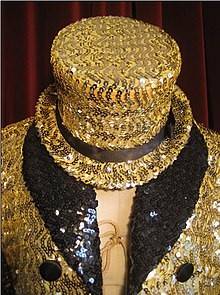
A replica costume based on the film's golden sequined eat-tail coat worn by Little Nell, recreated by fan Mina Credeur of Houston, Texas.
Some of the costumes from the movie had been originally used in the stage product. Props and set pieces were reused from old Hammer Horror productions and others. The tank and dummy used for Rocky'southward birth originally appeared in The Revenge of Frankenstein (1958). These references to earlier productions, in addition to cutting costs, enhanced the cult status of the film.[27]
Costume designer Sue Blane was non great on working for the film until she became aware that Curry, an old friend, was committed to the projection. Curry and Blane had worked together in Glasgow'south Citizens Theatre in a product of The Maids, for which Curry had worn a woman'south corset. Blane bundled for the theatre to loan her the corset from the other production for Rocky Horror.[28] Blane admits that she did not conduct research for her designing, had never seen a science fiction movie, and is acutely aware that her costumes for Brad and Janet may take been generalizations.
When I designed Rocky, I never looked at whatever scientific discipline fiction movies or comic books. Ane just automatically knows what spacesuits await similar, the same way 1 intuitively knows how Americans dress. I had never been to the United States, merely I had this stock-still idea of how people looked there. Americans wore polyester so their wearing apparel wouldn't crease, and their trousers were a bit too brusque. Since they're very swell on sports, white socks and white T-shirts played an integral office in their wardrobe. Of form, since doing Rocky I accept been to the United States and acknowledge information technology was a bit of a generalization, but my ideas worked perfectly for Brad and Janet.[28]
The budget for the film was US$one,600,000, far more than than the stage production budget, but having to double upward on costumes for the movie product was expensive. For filming, corsets for the finale had to exist doubled for the pool scene, with one version drying while the other was worn on set. While many of the costumes are verbal replicas from the phase productions, other costumes were new to filming, such every bit Columbia'southward gold sequined swallow-tail coat and top hat and Magenta's maid'due south compatible.[28]
Blane was amazed by the recreation and understanding of her designs by fans.[28] When she showtime heard that people were dressing up, she thought information technology would be tacky, but was surprised to run into the depth to which the fans went to recreate her designs. Rocky Horror fan Mina Credeur, who designs costumes and performed as Columbia for Houston's operation group, states that "the best role is when everyone leaves with a big grinning on their face," noting that there'south "such a kitschiness and campiness that it seems to exist winking at y'all."[29] The film however plays at many theatre locations and Rocky Horror costumes are often made for Halloween, although many require much time and effort to make.[30]
Championship sequence [edit]
The pic starts with the screen fading to black and oversized, disembodied female lips announced overdubbed with a male phonation,[27] [31] establishing the theme of androgyny to be repeated every bit the motion-picture show unfolds.[32] The opening scene and song, "Science Fiction/Double Feature", consists of the lips of Patricia Quinn (who appears in the film later as the character Magenta and as 'Trixie the Usherette' in the original London production, where she also sings the song) only has the vocals of actor and Rocky Horror creator, Richard O'Brien (who appears as Magenta's brother Riff Raff). The lyrics refer to science fiction and horror films of the past and list several flick titles from the 1930s to the 1960s, including The 24-hour interval the Globe Stood Still (1951), Flash Gordon (1936), The Invisible Man (1933), Male monarch Kong (1933), It Came from Outer Infinite (1953), Medico Ten (1932), Forbidden Planet (1956), Tarantula (1955), The Mean solar day of the Triffids (1962), Expletive of the Demon (1957), and When Worlds Collide (1951).[eight]
Music [edit]
The soundtrack was released in 1975 by Ode Records and produced by English composer Richard Hartley. The anthology peaked at No. 49 on the U.South. Billboard 200 in 1978.[33] Information technology reached No. 12 on the Australian albums chart[34] and No. 11 on the New Zealand albums nautical chart.[35] The album is described as the "definitive version of the [Rocky Horror] score".[36]
- "Science Fiction/Double Feature" – The Lips (those of Patricia Quinn; voice of Richard O'Brien)
- "Dammit Janet" – Brad, Janet, and Chorus
- "There's a Light (Over at the Frankenstein Identify)" – Janet, Brad, Riff Raff, and Chorus
- "The Time Warp" – Riff Raff, Magenta, The Criminologist, Columbia, and Transylvanians
- "Sweetness Transvestite" – Frank
- "The Sword of Damocles" – Rocky and Transylvanians
- "I Can Make You a Man" – Frank with Brad, Janet, Riff Raff, Magenta, and Columbia
- "Hot Patootie – Bless My Soul" – Eddie and Transylvanians
- "I Can Brand You a Human being (Reprise)" – Frank, Janet, and Transylvanians
- "Bear upon-a, Touch-a, Affect-a, Touch Me" – Janet with Magenta, Columbia, Rocky, Brad, Frank, and Riff Raff
- "Once in a While" (deleted scene) – Brad
- "Eddie" – Dr. Scott, The Criminologist, Janet, Columbia, Frank, Rocky, Brad, Riff Raff, and Magenta
- "Planet Schmanet Janet (Wise Upwardly Janet Weiss)" – Frank
- "Planet Hot Dog" – Janet, Brad, and Dr. Scott
- "Rose Tint My Globe" – Columbia, Rocky, Janet, and Brad
- "Fanfare/Don't Dream It, Exist It" – Frank with Brad, Janet, Rocky, and Columbia
- "Wild and Untamed Thing" – Frank with Brad, Janet, Rocky, Columbia, and Riff Raff
- "I'g Going Home" – Frank and Chorus
- "The Time Warp (Reprise)" – Riff Raff and Magenta
- "Super Heroes" (simply present in the original UK release) – Brad, Janet, and Chorus
- "Science Fiction/Double Characteristic (Reprise)" – The Lips
Release [edit]

London release poster for xiv August 1975 premiere
The film opened in the United Kingdom at the Rialto Theatre in London on 14 August 1975 and in the Us on 26 September at the UA Westwood in Los Angeles.[37] [38] It did well at that location, just not elsewhere.[39] Before the midnight screenings' success, the motion picture was withdrawn from its 8 opening cities due to very small audiences, and its planned New York City opening on Halloween night was cancelled.[twoscore] Fox re-released the film effectually college campuses on a double-bill with another rock music moving picture parody, Brian De Palma's Phantom of the Paradise (1974), only again it drew small audiences.[40]
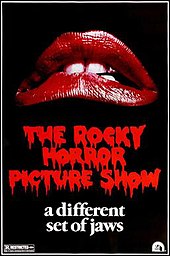
The iconic "Lips" poster, a parody of the affiche for the 1975 motion picture Jaws
A 2nd picture poster was created using a fix of reddish, lipstick painted lips with the tagline "A Different Prepare of Jaws", a spoof of the poster for the moving picture Jaws (which was also released in 1975).[27] The lips of former Playboy model Lorelei Shark are featured on the poster.[41]
With Pink Flamingos (1972) and Reefer Madness (1936) making money in midnight showings nationwide, a Play a joke on executive, Tim Deegan, was able to talk distributors into midnight screenings,[32] starting in New York City on April Fools' Day of 1976.[40] Information technology was the "Hugger-mugger" film, on 20 May, in the first Seattle International Film Festival.[42] The cult post-obit started presently subsequently the moving picture began its midnight run at the Waverly Theater in New York City,[39] [ folio needed ] then spread to other counties in New York, and to Uniondale, Long Island. Rocky Horror was non only found in the larger cities but throughout the United States, where many attendees would get in free if they arrived in costume. The western partitioning of the film's release included the U.A. Cinemas in Fresno and Merced, the Movie theater J. in Sacramento, the UC Theatre in Berkeley and the Covell in Modesto. In New Orleans, an early organised performance group was agile with the release at that place, also as in such cities as Pittsburgh, Pennsylvania, and Chicago (at the Biograph Theater). Before long, nearly every screening of the pic was accompanied by a alive fan cast.[43]

xix January 1978, opening at the UA Movie theatre, Merced, California
The Rocky Horror Picture show Evidence is considered to be the longest-running release in picture history.[5] [44] It benefited from a 20th Century Fox policy that made archival films bachelor to theatres at any time.[45] Having never been pulled by 20th Century Fox from its original 1975 release, information technology continues to play in cinemas.[46] [47] After The Walt Disney Company acquired 20th Century Fox in 2019 and began withdrawing archival Play a trick on movies from theatres to exist placed into the Disney Vault, the company made an exception in the case of The Rocky Horror Picture Show to let the traditional midnight screenings to continue.[45] [48]
Home media [edit]
A Super viii version of selected scenes of the film was made bachelor.[49] In 1983, Ode Records released "The Rocky Horror Picture Show, Audience Par-Tic-I-Pation Album", recorded at the 8th Street Playhouse. The recording consisted of the flick's audio and the standardized call-backs from the audience.[l]
A home video release was made bachelor in 1987 in the Great britain.[51] In the US, the picture (including documentary footage and extras) was released on VHS on eight November 1990, retailing for $89.95.[37]
The picture was released on DVD in 2000 for the picture's 25th anniversary. A 35th ceremony edition Blu-ray was released by 20th Century Fox Dwelling house Amusement in the The states on 19 October 2010. The disc includes a newly created 7.1 surround sound mix, the original theatrical mono sound mix, and a 4K/2K image transfer from the original camera negative. In addition, new content featuring karaoke and a fan performance were included.[52] A 45th anniversary edition Blu-ray was released in September 2020 past Walt Disney Studios Habitation Entertainment.[53]
In October 2021, the film was added to Disney+ on the Star hub for users in locations such as the UK, Ireland and Canada.[54]
Reception [edit]
Chicago Sun-Times critic Roger Ebert noted that when showtime released, The Rocky Horror Picture Show was "ignored by pretty much anybody, including the future fanatics who would somewhen count the hundreds of times they'd seen it". He considered information technology more a "long-running social phenomenon" than a movie, rating it 2.v out of 4 stars and describing Back-scratch every bit "the best thing in the movie, perchance because he seems to be having the most fun" only thinking the story would work ameliorate performed on stage for a live audience.[55] Bill Henkin noted that Multifariousness thought that the "campy hijinks" of the moving-picture show seemed labored, and also mentioned that the San Francisco Chronicle 's John Wasserman, who had liked the stage play in London, constitute the motion picture "lacking both charm and dramatic affect". Newsweek, in 1978, chosen the motion-picture show "tasteless, plotless and pointless".[56]
Review aggregator website Rotten Tomatoes gives the film a rating of 78% based on 45 reviews, and an average grade of 6.9/ten, with the critical consensus reading "The Rocky Horror Moving-picture show Show brings its quirky characters in tight, but it's the narrative thrust that really drives audiences insane and keeps 'em doing the fourth dimension warp once again".[57] A number of contemporary critics find it compelling and enjoyable considering of its offbeat and bizarre qualities; the BBC summarised: "for those willing to experiment with something a petty fleck different, a little flake outré, The Rocky Horror Picture Prove has a lot to offer."[58] The New York Times called it a "low-upkeep freak show/cult classic/cultural establishment" with "tricky" songs.[59] Geoff Andrew, of Time Out, noted that the "string of hummable songs gives it momentum, Gray's admirably direct-faced narrator holds information technology together, and a run on black lingerie takes intendance of about everything else", rating information technology four out of v stars.[lx] On the other mitt, Dave Kehr of the Chicago Reader considered the wit to exist "too weak to sustain a film" and thought that the "songs all sound the same".[61]
In 2005, the pic was selected for preservation in the United States National Pic Registry by the Library of Congress as being "culturally, historically, or aesthetically meaning".[62] [63]
Cult following [edit]
Origins [edit]

Dori Hartley and Sal Piro at the Waverly Theatre in New York in 1977
The Rocky Horror Picture Show helped shape atmospheric condition of cult film's transition from art-business firm to grind-house fashion.[64] The film adult a cult post-obit in 1976 at the Waverly Theatre in New York, which developed into a standardized ritual. According to J. Hoberman, author of Midnight Movies, information technology was subsequently five months into the motion picture's midnight run when lines began to exist shouted past the audition. Louis Farese Jr., a normally quiet teacher, upon seeing the graphic symbol Janet identify a newspaper over her head to protect herself from rain, yelled, "Purchase an umbrella, you inexpensive bitch." Originally, Louis and other Rocky Horror pioneers, including Amy Lazarus, Theresa Krakauskas, and Neb O'Brian, did this to entertain each other, each week trying to come up up with something new to make each other express joy. This quickly caught on with other theatre-goers and thus began this cocky-proclaimed "counter bespeak dialogue", which became standard do and was repeated nearly verbatim at each screening.[9] Performance groups became a staple at Rocky Horror screenings due in role to the prominent New York City fan cast.[39] [ folio needed ] The New York Metropolis cast was originally run past former schoolteacher and stand-up comic Sal Piro and his friend Dori Hartley, the latter of whom portrayed Dr. Frank N. Furter and was one of several performers, including Will Kohler as Brad Majors, Nora Poses as Janet, and Lilias Piro as Magenta, in a flexible rotating cast.[65] The performances of the audience were scripted and actively discouraged improvising, existence conformist in a like way to the repressed characters.[66]

D. Garrett Gafford and Terri Hardin, Tiffany Theater Hollywood, 1978
On Halloween in 1976, people attended in costume and talked back to the screen, and by mid-1978, Rocky Horror was playing in over 50 locations on Fridays and Saturdays at midnight. Newsletters were published past local performance groups, and fans gathered for Rocky Horror conventions.[40] By the finish of 1979, there were twice-weekly showings at over 230 theatres.[40] The National Fan Club was established in 1977 and afterward merged with the International Fan Order. The fan publication The Transylvanian printed a number of issues, and a semi-regular affiche magazine was published besides as an official magazine.[64]
Performance groups in the Los Angeles area originated at the Fox Theatre in 1977, where Michael Wolfson won a look-akin competition every bit Frank North. Furter, and won another at the Tiffany Theater on Sunset Boulevard. Wolfson's grouping somewhen performed in all of the 50.A. expanse theatres screening Rocky Horror, including the Balboa Theater in Balboa, The Cove at Hermosa Beach, and The Sands in Glendale. He was invited to perform at the Sombrero Playhouse in Phoenix, Arizona.[ commendation needed ] At the Tiffany Theatre, the audition performance cast had the theatre'southward full cooperation; the local performers entered early and without charge. The fan playing Frank for this theatre was a transgender performer, D. Garret Gafford, who was out of work in 1978 and trying to raise the funds for a gender reassignment while spending the weekends performing at the Tiffany.[39] [ page needed ] [67] Soon, the live action rendition of The Rocky Horror Movie Show is available for omnipresence in various locations in Los Angeles, typically Saturday nights at midnight.[ commendation needed ]

San Francisco's Strand Theatre, 1979. Linda Forest, Marni Scofidio, Denise Erickson, and Jim Curry
By 1978, Rocky Horror had moved from an before San Francisco location to the Strand Theatre located nearly the Tenderloin on Market Street.[68] The performance grouping there, Double Characteristic/Celluloid Jam, was the first to act out and perform nigh the unabridged moving picture, unlike the New York cast at that time. The Strand cast was put together from former members of an early on Berkeley group, disbanded due to less than enthusiastic management. Frank Northward. Furter was portrayed past Marni Scofidio, who, in 1979, attracted many of the older performers from Berkeley. Other members included Mishell Erickson as Columbia, her twin sister Denise Erickson every bit Magenta, Kathy Dolan every bit Janet, and Linda "Lou" Woods as Riff Raff. The Strand group performed at two large science fiction conventions in Los Angeles and San Francisco, were offered a spot at The Mabuhay, a local punk society, and performed for children's television of Argentina.[39] [ folio needed ]
Legacy [edit]
Annual Rocky Horror conventions are held in varying locations, lasting days. Tucson, Arizona has been host a number of times, including 1999 with "El Fishnet Fiesta", and "Queens of the Desert" held in 2006.[69] Vera Dika wrote that, to the fans, Rocky Horror is ritualistic and comparable to a religious upshot, with a compulsive, repeated bike of going abode and coming dorsum to see the pic each weekend.[9] The audition call-backs are similar to responses in church during a mass.[nine] Many theatre troupes be across the United States that produce shadow-cast performances where the actors play each part in the film in full costume, with props, as the movie plays on the big screen in a picture show theatre.[70] [71] O'Brien's Orchestra, formerly known as the Queerios (based in Austin, Texas), is the longest running shadow-cast in Texas.[72]
The movie has a global post-obit and remains pop.[73] Subcultures such as Rocky Horror accept also constitute a place on the Internet.[74] Audience participation scripts for many cities are available for download from the internet.[27] The internet has a number of Rocky Horror fan-run websites with various quizzes and information, specializing in different content, assuasive fans to participate at a unique level.[32]
LGBT influence [edit]
Members of the LGBT customs comprised a large function of the Rocky Horror cult following: they identified with the embrace of sexual liberation and androgyny, and attended show after show, slowly forming a community. Judith A. Peraino compares Brad and Janet's initiation into Frank Due north. Furter's earth to the self-discovery of 'queer identity', and to the traditional initiation of 'virgins' in the shadow screenings.[75] June Thomas describes the midnight screenings in Delaware as a 'very queer scene,' which increased visibility for the LGBT community: "The folks standing in line outside the Land in fishnets and makeup every Saturday night undoubtedly widened the sphere of possibilities for gender expression on Chief Street."[76] [77]
The Rocky Horror Flick remains a cultural phenomenon in both the U.S. and U.K.[78] [79] Cult film participants are ofttimes people on the fringe of society that find connectedness and community at the screenings,[fourscore] although the film attracts fans of differing backgrounds all over the world.[81]
"Bisexuality, The Rocky Horror Moving picture Bear witness, and Me", by Elizabeth Reba Weise, is part of the publication, Bi Whatever Other Name: Bisexual People Speak Out (1991), an anthology edited by Loraine Hutchins and Lani Ka'ahumanu[82] [83] virtually the history of the mod bisexual rights movement that is 1 of the showtime publications of bisexual literature.[84]
Cultural influence [edit]
The Rocky Horror Motion-picture show Prove has been featured in a number of other characteristic films and goggle box serial over the years. Episodes of The Simpsons, The Venture Bros., The Boondocks, Glee, The Drew Carey Bear witness, That '70s Show, Deutschland 86, and American Dad! spotlight Rocky Horror, as exercise films such as Vice Squad (1982), Halloween II (2009), and The Perks of Existence a Wallflower (2012).[37] The 1980 film Fame featured the audition reciting their callback lines to the screen and dancing the Fourth dimension Warp,[85] the dance from the stage evidence and flick, which has become a novelty dance at parties.[86] Director Rob Zombie cited Rocky Horror as a major influence on his movie House of thousand Corpses (2003),[87] while the film's fan civilisation of cosplaying and audience participation during screenings laid the groundwork for the similarly influential cult following surrounding Tommy Wiseau's The Room (2003).[88] [89] Rocky Horror also inspired John McPhail's zombie musical Anna and the Apocalypse (2018).[90]
Sequel [edit]
In 1979, O'Brien wrote a projected sequel to the film titled Rocky Horror Shows His Heels. This script would have featured the render of all of the characters from the original film, and O'Brien wished to largely use the original production team to make the new film; all the same, Sharman did not wish to revisit the original concept then direct, and Tim Back-scratch did not wish to reprise his function.[ citation needed ]
Instead, in 1981, Sharman reunited with O'Brien to film Daze Treatment, a stand-solitary feature that was non a straight sequel to the original film.[ii] This movie was originally conceived and written in 1980 under the title The Brad and Janet Evidence, using most of the songs from the original project Rocky Horror Shows His Heels with lyrical adjustments, and depicting the characters' standing adventures in the town of Denton; however, these plans had to be adjusted due to a Screen Actors Guild strike. The eventual product would entail the entire film beingness shot inside a sound phase. Shock Treatment was poorly received by critics and audiences upon release (in no small function due to the principal cast of Curry, Sarandon and Bostwick not returning) merely over time has built a small cult following, though non nearly equally stiff as the first film.[91]
10 years later, O'Brien wrote another script intended as a directly sequel to the cult classic, entitled Revenge of the One-time Queen.[92] Producer Michael White had hoped to brainstorm work on the production and described the script every bit existence "in the same mode as the other one. Information technology has reflections of the past in it."[93] Revenge of the Old Queen had apparently commenced pre-product; however, after studio caput Joe Roth was ousted from Play tricks in 1993, the projection was shelved indefinitely. Although the script has not been published, bootleg copies can be read on the internet, and one song from the project's original demo tape circulates among fans. The script is currently owned past Fox, which produced the two original films. Nigh individuals associated with the project, including O'Brien, agree that the film will probably never be made, owing to the failure of Stupor Treatment and the crumbling of the original cast.[94]
Between 1999 and 2001, O'Brien was working on a 3rd attempted sequel project with the working title Rocky Horror: The 2d Coming,[95] first to exist fabricated as a stage production, with an option to create a film if met with success. This script would largely integrate plot elements from Rocky Horror Shows His Heels, but with all-new songs. O'Brien completed a first draft of this script (which was read by Terry Jones[96]) just had difficulties finalising anything beyond the first act, and little more has been heard of this projection since the mid-2000s.[ citation needed ]
In jump 2015, O'Brien produced Shock Handling for the theatrical stage with a premiere at the Male monarch'southward Head Theatre in Islington, London.[97] [98]
Remake [edit]
"The Rocky Horror Glee Bear witness" aired on 26 October 2010, as part of the second season of the idiot box series Glee—and recreated several scenes from the picture show, including the opening credits. It featured Barry Bostwick and Meat Loaf in cameo roles.[99] An EP album covering vii songs from the movie was released on 19 October 2010.[100]
On 10 April 2015, the Fox Network announced information technology would air a modern-day reimagining of the film, titled The Rocky Horror Motion-picture show Show: Let's Do the Fourth dimension Warp Again.[101] [102] On 22 October 2015, Pull a fast one on announced that the office of Dr. Frank N. Furter would be played past transgender actress Laverne Cox.[103] Ryan McCartan played Brad, alongside Victoria Justice as Janet, with Reeve Carney as Riff Raff and singer/model Staz Nair as Rocky.[104] Adam Lambert portrays Eddie.[105] Tim Curry, who portrayed Dr. Frank N. Furter in the original flick, portrays the Criminologist.[106] On 1 February 2016, the network announced that Broadway veteran Annaleigh Ashford would portray Columbia.[107] On 5 February 2016, Ben Vereen joined the cast as Dr. Everett von Scott.[108]
Kenny Ortega, best known for the High School Musical franchise and Michael Jackson'south This Is It (2009) directed, choreographed and executive-produced the remake; Lou Adler, who was an executive producer of the original flick, has the same office for the new picture show, which premiered on Play tricks on 20 October 2016.[109]
Come across besides [edit]
- List of American films of 1975
- Cross-dressing in flick and tv set
- List of films featuring extraterrestrials
- List of films featuring Frankenstein'southward monster
References [edit]
- ^ "ROCKY HORROR Motion-picture show SHOW (AA)". British Lath of Film Classification. 17 June 1975. Retrieved 18 April 2015.
- ^ a b Armstrong, Richard; et al. (vii November 2007). The Rough Guide to Film. Rough Guides. p. 506. ISBN978-i-4053-8498-8.
- ^ a b "The Rocky Horror Moving picture Prove". American Film Institute. Archived from the original on 18 September 2017. Retrieved 11 Dec 2015.
- ^ Solomon, Aubrey (2002). Twentieth Century Fox: A Corporate and Financial History . Scarecrow Press. p. 258. ISBN978-0-8108-4244-i.
- ^ a b Ivan-Zadeh, Larushka (19 June 2020). "The Rocky Horror Picture Show: The pic that'southward saved lives". BBC . Retrieved 27 September 2020.
- ^ Thompson, Dave (1 February 2016). The Rocky Horror Picture Show FAQ: Everything Left to Know Nearly the Campy Cult Classic. Applause Theatre & Movie house Books. p. 1785. ISBN978-1-4950-0747-seven.
- ^ "Rocky Horror Picture Show – a How-To Guide for Audience Participation". Archived from the original on 1 November 2020. Retrieved 19 January 2022.
- ^ a b c d e f Miller, Scott (2011). Sex, Drugs, Stone & Gyre, and Musicals. UPNE. p. 127. ISBN978-i-5555-3761-half dozen.
- ^ a b c d Dika, Vera (ix June 2003). Recycled Culture in Gimmicky Art and Film: The Uses of Nostalgia. Cambridge Academy Printing. p. 112. ISBN978-0-5210-1631-5.
- ^ a b Knapp, Raymond (2 March 2009). The American Musical and the Operation of Personal Identity . Princeton University Printing. p. 240. ISBN978-0-6911-4105-3.
- ^ Auslander, Philip (2006). Performing Glam Rock: Gender and Theatricality in Popular Music . Academy of Michigan Press. p. 49.
- ^ a b Reynolds, Simon (eleven October 2016). Daze and Awe: Glam Rock and Its Legacy, from the Seventies to the Twenty-Beginning Century . Harper Collins. ISBN978-0-0622-7981-1.
- ^ a b c d due east Eagan, Daniel (26 November 2009). America's Film Legacy: The Administrative Guide to the Landmark Movies in the National Picture show Registry. Continuum International Publishing Group, Limited. p. 2086. ISBN978-i-4411-7541-0.
- ^ Thomson, Brian (1998). The Rocky Horror Scrapbook. New York: Interfishnet. p. vi. ISBN978-0-2339-9581-6.
- ^ Shuker, Roy (1 November 1994). Understanding popular music (annotated ed.). Routledge. p. 160. ISBN978-0-415-10722-8.
- ^ Quisling, Erik; Williams, Austin Lowry (2003). Directly Whisky: A Living History of Sexual practice, Drugs, and Rock 'n' Curlicue on the Dusk Strip. Bonus Books. p. 245. ISBN978-i-5662-5197-six.
- ^ Botto, Louis; Mitchell, Brian Stokes (2002). At This Theatre: 100 Years of Broadway Shows, Stories and Stars . New York; Milwaukee, WI: Applause Theatre & Cinema Books/Playbill. p. 33. ISBN978-1-55783-566-6.
- ^ Newland, Paul (2010). Don't Look Now: British Cinema in the 1970s. Intellect Books. p. 138. ISBN978-one-8415-0320-2.
- ^ Williams, sally. "Elstree Studios". The Gratuitous Library. Farlex, Inc. Retrieved 16 March 2014.
- ^ Huckvale, David (28 May 2008). Hammer Film Scores and the Musical Avant-Garde. McFarland. p. 150. ISBN978-0-7864-3456-5 . Retrieved 30 September 2012.
- ^ Fisher, Stuart (24 Oct 2013). British River Navigations: Inland Cuts, Fens, Dikes, Channels and Non-tidal Rivers. A&C Blackness. p. 227. ISBN978-1-4729-0668-7.
- ^ Hallenbeck, Bruce G. (30 April 2009). Comedy-Horror Films: A Chronological History, 1914–2008. McFarland. p. 109. ISBN978-0-7864-5378-eight.
- ^ Henkin (1979), p. xvi
- ^ Harpole, Charles (5 Nov 1999). History of the American movie theatre (1st ed.). Charles Scribner's Sons. pp. 212–213. ISBN978-0-6848-0463-7.
- ^ Hadleigh, Boze (i Jan 2001). The Lavender Screen: The Gay and Lesbian Films: Their Stars, Makers, Characters, and Critics (Revised ed.). Citadel. pp. 132–135. ISBN978-0-8065-2199-ii . Retrieved 17 November 2021.
- ^ "Mick Rock". Official web site. 2011. Archived from the original on 18 September 2012. Retrieved 4 October 2012.
- ^ a b c d Riley, Samantha Michele (2008). Condign the Wig: Mis/identifications and Citationality in Queer Rock Musicals. p. 22. ISBN978-0-549-53382-5.
- ^ a b c d Siegel, Robert. "Making The Rocky Horror Picture". Blu-ray.com. Retrieved 27 March 2014.
- ^ Keppler, Nick (7 June 2007). "The Beautiful Creatures". Houston Press . Retrieved 28 March 2014.
- ^ Jones, Melanie (xviii October 2011). "Rocky Horror Picture Show Costumes: DIY Ideas for Halloween 2011". International Business concern Times . Retrieved 15 November 2014.
- ^ Laderman, David (1 March 2010). Punk Slash! Musicals: Tracking Slip-Sync on Picture show. University of Texas Press. p. 32. ISBN978-0-292-77791-0.
- ^ a b c Lancaster, Kurt; Mikotowicz, Thomas J. (1 January 2001). Performing the Force: Essays on Immersion Into Science Fiction, Fantasy, and Horror Environments. McFarland. p. 128. ISBN978-0-7864-0895-5.
- ^ "The Rocky Horror Picture Evidence > Charts & Awards". AllMusic . Retrieved three October 2010.
- ^ Kent, David (1993). Australian Nautical chart Book 1970–1992. St Ives, New Southward Wales: Australian Nautical chart Book. p. 282. ISBN978-0-646-11917-v.
- ^ "The Rocky Horror Movie Show (album)". New Zealand charts portal . Retrieved 3 October 2010.
- ^ Ruhlmann, William. "The Rocky Horror Film > Review". Allmusic . Retrieved 3 Oct 2010.
- ^ a b c Champion, Lindsay (14 August 2013). "Happy Birthday, Dear Rocky! 38 Freaky Facts About The Rocky Horror Motion picture". Broadway.com . Retrieved 27 March 2014.
- ^ "FLASHBACK: The Rocky Horror Pic Premieres In North America (September 26, 1975)". In Magazine. 26 September 2019. Retrieved 14 August 2020.
- ^ a b c d e Henkin, William A.; Henkin, Bill (1 August 1979). The Rocky Horror Picture Bear witness Book. New York City: Penguin Books. p. 27. ISBN978-0-4522-6654-4 . Retrieved 17 November 2021.
- ^ a b c d e Samuels (1983), p. 11
- ^ "Lorelei Shark Interview – She IS The Rocky Horror LIPS – Scott Michaels Dearly Departed online". YouTube. seven June 2016. Archived from the original on 11 December 2021. Retrieved xv August 2016.
- ^ Caldbick, John (v Jan 2012). "Offset Seattle International Film Festival (SIFF) opens at Moore Egyptian Theatre on May 14, 1976". HistoryLink. Archived from the original on xix October 2016. Retrieved 27 January 2022.
- ^ Henkin 1979, p. 118. sfn error: no target: CITEREFHenkin1979 (aid)
- ^ "Fox Celebrates 25 Years of Absolute Pleasure, Pop Civilization Phenomenon and Midnight Classic" (Press release). RHPS Official Fan Site. 24 August 2000. Retrieved thirteen June 2007.
- ^ a b Zoller-Seitz, Matt (24 Oct 2019). "Disney Is Quietly Placing Classic Fox Movies Into Its Vault, and That'due south Worrying". Vulture . Retrieved 24 October 2019.
- ^ "RHPS regular showtimes". Retrieved thirteen Apr 2013.
- ^ Smith, Zach (27 Oct 2010). "What keeps The Rocky Horror Moving-picture show Testify flame burning for more than ii decades in Raleigh?". Indy Week . Retrieved 13 April 2013.
- ^ Henriksen, Erik (29 August 2019). "As Disney Cracks Downwards on Repertory Screenings, Portland'south Independent Theaters Accommodate". Portland Mercury . Retrieved 31 October 2019.
- ^ Piro & Hess (1991), p. 77
- ^ Peraino, Judith A. (xxx October 2005). Listening to the Sirens: Musical Technologies of Queer Identity from Homer to Hedwig. Oakland, California: Academy of California Press. p. 234. ISBN978-0-5209-2174-0.
- ^ "British Board of Film Classification: RHPS". Retrieved 14 April 2016.
- ^ "An Accented Pleasure...For 35 Years" (Press release). RHPS Official Fan Site. four August 2010. Retrieved 17 November 2021.
- ^ "THE ROCKY HORROR Moving picture Evidence 45th Ceremony Limited-Edition SteelBook Arrives Sept. xv". BroadwayWorld. 9 September 2020. Retrieved 27 September 2020.
- ^ ""Rocky Horror Moving picture Show" Coming Soon To Disney+ (United kingdom of great britain and northern ireland/Republic of ireland)". What's On Disney Plus. 23 September 2021. Retrieved three October 2021.
- ^ Ebert, Roger (1 January 1975). "The Rocky Horror Picture Show". Chicago Sun-Times . Retrieved 5 April 2014 – via Rogerebert.com.
- ^ Picart, Caroline Joan (two July 2003). Remaking the Frankenstein Myth on Moving picture: Betwixt Laughter and Horror. SUNY Press. p. 62. ISBN978-0-7914-5770-2.
- ^ "The Rocky Horror Picture Testify". Rotten Tomatoes . Retrieved nineteen September 2021.
- ^ "The Rocky Horror Picture Evidence". BBC. 25 August 2000. Retrieved five Apr 2014.
- ^ Armstrong, Derek (26 April 2014). "The Rocky Horror Moving picture". The New York Times. Archived from the original on 26 April 2014. Retrieved 5 Apr 2014.
- ^ "The Rocky Horror Movie Show". Time Out . Retrieved v Apr 2014.
- ^ Kehr, Dave (23 October 2012). "The Rocky Horror Picture Show". Chicago Reader . Retrieved 17 November 2021.
- ^ "National Film Registry Titles 1989–2013". Library of Congress. xx November 2013. Archived from the original on 19 April 2012. Retrieved 18 February 2014.
- ^ "Rocky Horror Picture show Show". Library of Congress Information Bulletin. Library of Congress: 23. 2006.
- ^ a b Mathijs, Ernest; Mendik, Xavier (1 December 2007). The Cult Moving picture Reader. McGraw-Hill International. p. 395. ISBN978-0-335-21923-0.
- ^ Henkin 1979, p. 106. sfn fault: no target: CITEREFHenkin1979 (assist)
- ^ Mathijs, Ernest; Sexton, Jamie (30 March 2012). Cult Cinema. John Wiley & Sons. p. 101. ISBN978-1-4443-9642-3.
- ^ Overand, William (xix July 1978). "Saturday Nighttime Fervor at the Tiffany Theater". Los Angeles Times . Retrieved 17 November 2021.
- ^ Stewart, Jim (2011). Folsom Street Dejection: A Memoir of 1970s SoMa and Leatherfolk in Gay San Francisco. Palm Bulldoze Publishing. p. 109. ISBN978-1-8908-3403-6.
- ^ Gay, Gerald Thousand. (13 March 2014). "'Rocky Horror' shines at El Fishnet Fiesta". Arizona Daily Star. Tucson. Retrieved 18 March 2014.
- ^ "Come encounter Northern Virginia'south only Rocky Horror shadowcast!". Transylvanian Concubines. Archived from the original on 9 February 2016. Retrieved x February 2016.
- ^ "Where Rocky Horror Lives in Los Angeles!". Sins O' The Mankind. thirty Jan 2012. Archived from the original on iv Feb 2016. Retrieved 10 February 2016.
- ^ "Austin's very own Rocky Horror Shadow Bandage!". O'Briens Orchestra . Retrieved 29 June 2021.
- ^ Batchelor, Bob (December 2011). Cult Pop Culture: How the Fringe Became Mainstream. ABC-CLIO. p. 52. ISBN978-0-313-35780-0.
- ^ Ross, Sharon Marie (23 September 2011). Across the Box: Idiot box and the Cyberspace. John Wiley & Sons. p. 31. ISBN978-i-4443-5865-0.
- ^ Peraino, Judith A. (2006). Listening to the sirens: musical technologies of queer identity from Homer to Hedwig . Berkeley: University of California Press. pp. 249–252. ISBN978-0-5202-1587-0. OCLC 58043161.
- ^ Thomas, June (31 October 2014). "How The Rocky Horror Flick Smashed Open America'south Closets". Slate . Retrieved 15 November 2018.
- ^ Wong, Curtis M. (17 October 2018). "Why 'Rocky Horror Picture Prove' Remains A Queer Cinematic Milestone". Huff Post . Retrieved 15 November 2018.
- ^ Smith, Justin (28 February 2010). Withnail and Us: Cult Films and Moving picture Cults in British Movie theatre . I.B.Tauris. p. 32. ISBN978-0-85771-793-1.
- ^ Tucker, Betty Jo (2004). Susan Sarandon: A True Maverick. Wheatmark, Inc. p. 139. ISBN978-1-58736-300-9.
- ^ Lippy, Charles H. (2006). Faith in America: Changes, Challenges, New Directions. Westport, Connecticut: Greenwood Publishing Group. p. 112. ISBN978-0-275-98605-vi.
- ^ Blackshaw, Tony (18 July 2013). Routledge Handbook of Leisure Studies. London: Routledge. p. 117. ISBN978-1-136-49559-5.
- ^ Play a trick on, Ronald (3 April 2013). Hutchins, Loraine; Ka'ahumanu, Lani (eds.). Current Research on Bisexuality. London: Routledge. p. 178. ISBN978-1-136-56963-0.
- ^ Highleyman, Liz A. "A Brief History of the Bisexual Movement". Bisexual Resources Center. Archived from the original on 26 September 2007. Retrieved 23 July 2016.
- ^ Burleson, William (iv Apr 2014). Bi America: Myths, Truths, and Struggles of an Invisible Customs. London: Taylor & Francis. p. 189. ISBN978-one-317-71260-2.
- ^ Ortiz, Lori (31 March 2011). Disco Dance. ABC-CLIO. p. 147. ISBN978-0-313-37747-1.
- ^ Silvester, Delia (21 December 2013). Dance and Movement Sessions for Older People: A Handbook for Activity Coordinators and Carers. Jessica Kingsley. p. 47. ISBN978-0-85700-846-6.
- ^ Wood, Jennifer M. (21 Oct 2014). "eleven Things You Didn't Know About The Texas Chainsaw Massacre". Esquire. Archived from the original on 26 January 2018. Retrieved 24 September 2018.
- ^ Bather, Luke (xvi March 2017). "Everything You Need to Know About Cult Movie 'The Room' & Disaster Creative person Tommy Wiseau". Highsnobiety . Retrieved 27 July 2017.
- ^ Barton, Steve (10 Dec 2009). "Motion Motion picture Purgatory: The Room". Dread Central. Archived from the original on 19 June 2017. Retrieved 16 June 2017.
- ^ Fletcher, Rosie (30 June 2019). "Anna And The Apocalypse interview: the director on his zombie musical". Den of Geek . Retrieved thirty June 2019.
- ^ Cettl, Robert (12 December 2010). Film Tales. Wider Screenings TM. p. 94. ISBN978-0-9870500-0-7.
- ^ "Revenge of the Erstwhile Queen". RockyMusic . Retrieved 17 November 2021.
- ^ Van Gelder, Lawrence (13 September 1991). "'Rocky Horror' to 'Queen'". The New York Times . Retrieved iii Oct 2010.
- ^ Drees, Rich (27 September 2010). "Script Review: Revenge of the Former Queen". Picture Buff Online . Retrieved 30 July 2013.
- ^ Turner, Megan (23 September 1999). "'ROCKY' 2: With A Sequel to His Last "Picture Prove," Creator Richard O'Brien Does The Time Warp, Once more". New York Mail service . Retrieved 17 November 2021.
- ^ Fairgrieve, Martin A. (23 October 2001). "News on Rocky Horror 2 from THE MAN Himself!". Google Groups . Retrieved 17 November 2021.
- ^ Alberge, Dalya (30 November 2014). "As Rocky Horror sequel comes to stage, it seems creator was far ahead of his time". The Guardian. London. Retrieved 2 Dec 2014.
- ^ Allfree, Claire (22 Apr 2015). "Shock Treatment, King'south Head Theatre, review: 'infectious'". The Daily Telegraph. London. Archived from the original on eleven Jan 2022. Retrieved 17 June 2018.
- ^ Caulfield, Keith (27 October 2010). "Sugarland Tops Kings of Leon on Billboard 200". Billboard . Retrieved 17 November 2021.
- ^ Lipshutz, Jason (28 September 2010). "'Glee' Announces 'Rocky Horror' Album Details". Billboard . Retrieved 17 November 2021.
- ^ "'Rocky Horror Pic Show' TV Remake In Works At Equally Pull a fast one on Special". Borderline Hollywood. x April 2015. Retrieved xi April 2015.
- ^ "Fox remaking 'Rocky Horror Movie Show'". Entertainment Weekly. ten April 2015. Retrieved eleven Apr 2015.
- ^ "Laverne Cox starring in Rocky Horror remake". Digital Spy. 21 October 2015. Retrieved 23 July 2016.
- ^ Stanhope, Kate (4 January 2016). "Victoria Justice Joins Trick'south 'Rocky Horror Picture Testify' Remake". Billboard . Retrieved 4 January 2016.
- ^ Goldberg, Lesley. "Adam Lambert to Co-Star in Play tricks'due south 'Rocky Horror Picture Show'". The Hollywood Reporter . Retrieved 17 November 2021.
- ^ Spanos, Brittany (15 January 2016). "Tim Curry Lands Function in 'Rocky Horror Picture show Show' Remake". Rolling Rock . Retrieved 23 July 2016.
- ^ "Annaleigh Ashford Joins The Rocky Horror Picture Show". ComingSoon.cyberspace. 1 February 2016. Retrieved ii February 2016.
- ^ Moylan, Brian (19 October 2016). "The fan rituals that fabricated Rocky Horror Flick Evidence a cult archetype". The Guardian. London. ISSN 0261-3077. Retrieved 17 July 2017.
- ^ Jayson, Jay (22 October 2015). "Orange Is The New Black'southward Laverne Cox To Star In Rocky Horror Picture Evidence Remake". Comicbook.com.
Bibliography [edit]
- Armstrong, Richard; Charity, Tom; Hughes, Lloyd; Wintertime, Jessica (2007). The Rough Guide to Film. London: Rough Guides. p. 506. ISBN978-ane-4053-8498-viii.
- Batchelor, Bob (2012). Cult pop culture: how the fringe became mainstream. Santa Barbara, Calif: Praeger. ISBN978-0-313-35780-0.
- Blackshaw, Tony (2013). Routledge Handbook of Leisure Studies. Hoboken: Taylor and Francis. ISBN978-one-136-49559-5.
- Dika, Vera (2003). Recycled culture in contemporary art and film: the uses of nostalgia. Cambridge New York: Cambridge University Press. ISBN978-0-521-01631-v.
- Hallenbeck, Bruce (2009). Comedy-Horror Films. Jefferson, NC: McFarland. ISBN978-0-7864-3332-2.
- Harpole, Charles (1990). History of the American Cinema . New York: Scribner. ISBN978-0-684-80463-7.
- Henkin, Bill (1979). The Rocky Horror Motion picture Evidence Book. New York: Hawthorn Books. ISBN978-0-8015-6436-9.
- Hitchcock, Susan (2007). Frankenstein: a cultural history . New York: W.W. Norton. ISBN978-0-393-06144-four.
- Lancaster, Kurt (2001). Performing the force: essays on immersion into science fiction, fantasy, and horror environments. Jefferson, NC: McFarland. ISBN978-0-7864-0895-5.
- Lippy, Charles (2006). Religion in America changes, challenges, new directions. Westport, Conn: Praeger. ISBN978-0-275-98605-6.
- Leitch, Thomas (2002). Criminal offense Films. Cambridge: Cambridge Academy Press. ISBN978-0-521-64671-0.
- Mathijs, Ernest (2011). Cult cinema an introduction. Malden, Mass: John Wiley & Sons Ltd. ISBN978-1-4443-9642-3.
- Mathijs, Ernest (2008). The cult film reader. Maidenhead, Berkshire: Open University Press/McGraw-Hill Education. ISBN978-0-335-21923-0.
- Miller, Scott (2011). Sex activity, drugs, rock & gyre, and musicals. Boston: Northeastern University Printing. ISBN978-ane-55553-761-6.
- Peraino, Judith (2006). Listening to the sirens musical technologies of queer identity from Homer to Hedwig . Berkeley: University of California Press. ISBN978-0-520-92174-0.
- Picart, Caroline (2003). Remaking the Frankenstein myth on picture: between laughter and horror. Albany: State Academy of New York Press. ISBN978-0-7914-5770-2.
- Piro, Sal; Hess, Michael (1991). The Official Rocky Horror Picture Testify Audience Par-tic-i-pation Guide. London: Stabur Press. ISBN978-0-941613-16-3.
- Ross, Sharon (2011). Beyond the Box Telly and the Internet. Chicester: Wiley. ISBN978-ane-4443-5865-0.
- Samuels, Stuart (1983). Midnight Movies. New York: Collier Books. ISBN978-0-02-081450-4.
- Sandys, Jon (2007). Movie Mistakes Accept five. London: Virgin Books. ISBN978-0-7535-1113-8.
- Santino, Jack (1994). Halloween and other festivals of death and life. Knoxville: University of Tennessee Press. ISBN978-0-87049-813-8.
- Smith, Justin (2010). Withnail and us cult films and picture cults in British cinema. London: I.B. Tauris Distributed in the United States and Canada exclusively past Palgrave Macmillan. ISBN978-0-85771-793-1.
- Silvester, Delia (2013). Dance and Move Sessions for Older People A Handbook for Activity Coordinators and Carers. Metropolis: Jessica Kingsley Publishers. ISBN978-0-85700-846-vi.
- Stewart, Jim (2011). Folsom Street dejection: a memoir of 1970s SoMa and leatherfolk in gay San Francisco. San Francisco: Palm Drive Pub. ISBN978-ane-890834-03-6.
- Tucker, Betty (2004). Susan Sarandon: a truthful maverick. Tucson, Ariz: Hats Off. ISBN978-1-58736-300-ix.
External links [edit]
- Official website
- Official fan site
- The Rocky Horror Picture Prove at IMDb
- The Rocky Horror Film Show at Box Function Mojo
- The Rocky Horror Picture Show at Rotten Tomatoes
- The Rocky Horror Motion-picture show at Metacritic
- The Rocky Horror Picture Prove on YouTube—official trailer

beyersearattables.blogspot.com
Source: https://en.wikipedia.org/wiki/The_Rocky_Horror_Picture_Show
0 Response to "Rocky Horror Picture Show Fox Performing Arts Center October 13"
Post a Comment